
Menu
The Fisherman’s Tree. The Green Bean Tree. The Cigar Tree. This rugged tree of a thousand nicknames is a big friendly giant that steps straight out of our childhood memories. The list of Catalpa’s great qualities is as long as it is tall. (Some alive today are nearly 100′ tall!) From its flowers and giant leaves to its flood and salt tolerance, the Northern Catalpa is a beauty we love to share with our clients.
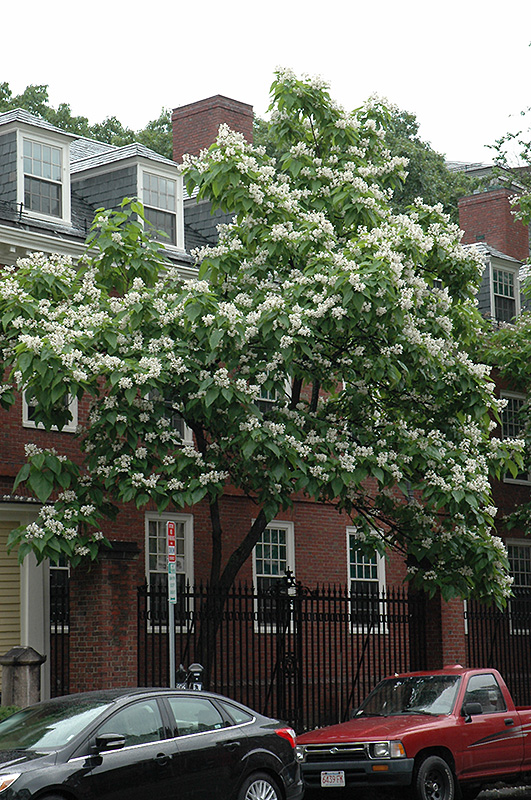
Catalpa’s large orchid-like flowers form in clusters of creamy white with bands of yellow and thin purple spots. While they don’t last very long, they are unique and beautiful. The pleasant sweet fragrance is perfectly accompanied by the giant heart-shaped leaves. Perfect fairy-garden plates that spark the imaginations of outdoorsy kids!
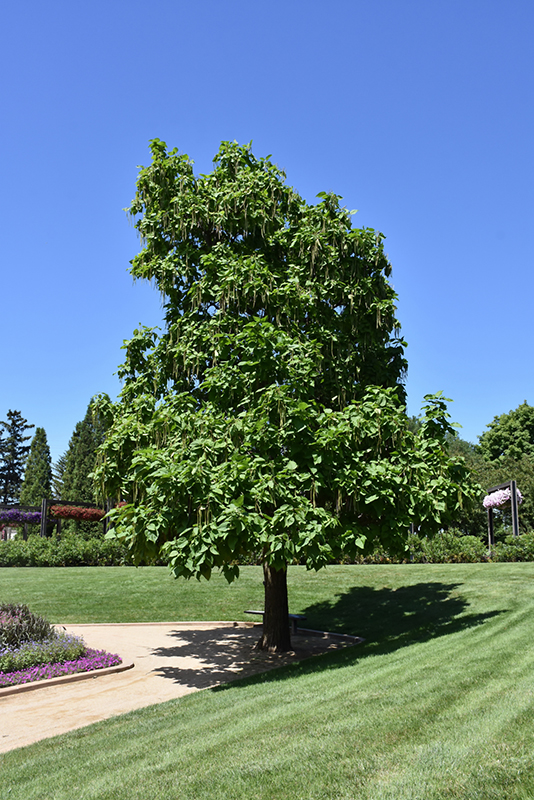
The big bean-shaped pods that follow the delicate flowers can be over a foot long. These “Green Beans” or “Cigars” are the primary reason that this tough native tree has been underused in urban and suburban landscape plantings. Should it be planted over your outdoor dining table? Probably not; but sited appropriate, its great qualities should outweigh the once-a-year chore of sweeping up the fallen bean pods.
Catalpas are one of the few truly flood-tolerant species in our Southern Wisconsin landscapes. They can be transplanted will great success along riverbanks and in floodplains; unlike most trees they can establish and succeed long term in sites with seasonal flooding. When we excavate a hole and the bottom is already partially filled with water – Catalpas are one of the very few species that will thrive there. These rugged giants will also tolerate nearly any Wisconsin soil pH condition, including the very alkaline conditions typical in the Southeastern corner of our state. Even though it is native to bottomlands and thrives in wild spaces, Catalpas also tolerate road salt. Talk about tough…
The Catalpa Sphinx moth (Ceratomia catalpae) relies on these trees to survive; they cannot feed on any other species. The larvae (caterpillars) are regarded as the perfect fishing bait for bass, giving our loved giant its other nickname of the Fisherman’s Tree. Thankfully, there are few serious insect problems in Wisconsin, at this time.
Of course, no plant is perfect. Catalpa wood is decay resistant, but brittle. Branch damage from storms is not uncommon. If verticillium is present, Catalpa is not a good choice as it is susceptible to this fungus and can succumb to wilt. Catalpa’s fall color is insignificant. Don’t let the blasé autumn tones dissuade you from adding one of these beautiful trees to your landscape. Just give it a maple as a neighbor, and enjoy your Fisherman’s Tree! Or Green Bean Tree! Or whatever you nickname you choose for your lovely specimen.
Learn more about the Northern Catalpa in our Plant Directory.
Nursery Hours
Sunday: 10:00am - 3:00pm
Monday: CLOSED
Tuesday: 9:00am - 6:00pm
Wednesday: 9:00am - 6:00pm
Thursday: 9:00am - 6:00pm
Friday: 9:00am - 6:00pm
Saturday: 9:00am - 4:00pm
Financing


Copyright © 2026 Piala’s Nursery & Garden Shop · All Rights Reserved